Introduction:
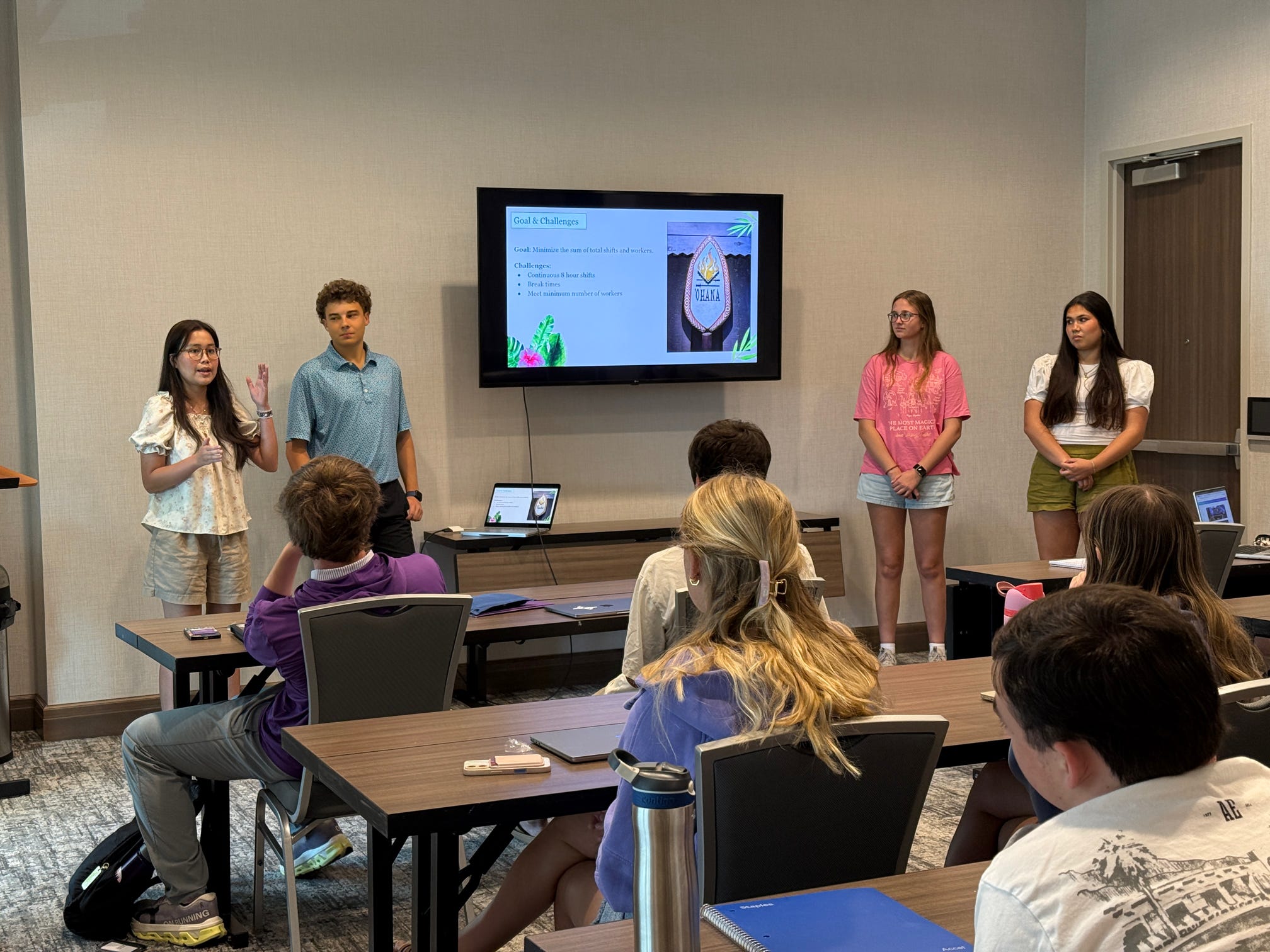
After a day touring the park, Magic Kingdom patrons love to relax and dine at ‘Ohana located in Disney’s Polynesian Resort. The restaurant specializes in American-Polynesian fusion cuisine offering all-you-can-eat, family-style Hawaiian-themed meals. Guests might even get serenaded by a ukelele player or a visit from Lilo and Stitch. Guaranteeing a great customer experience means having to schedule a lot of cast members to the restaurant throughout the day. 'Ohana restaurant opens at 8:00 AM till 1:45 AM the next day. In this blog post, I will share my experience of working on a project that I found interesting and challenging. I will also share my thoughts on the project and the lessons I learned from it.
Study case:
I want to build a mathematical model to efficiently schedule cast members to cover the workload in each period for the restaurant (without regard to specific roles). Ultimately, I want to minimize the number of cast members needed to cover the workload for every time period. Cast members have to work eight continuous hours that can begin at any time and take a 1-hour break. For every time period, there is a certain number of guests expected to visit the restaurant as the workload for that period. I am also provided a workload needed table to be covered during each of the 72 15-minute time periods during a typical day at 'Ohana.
There are two scenarios to consider:
- Each cast member gets a 60-minute break that can either be assigned to begin after working exactly 3 hours or after working exactly 5 hours.
- Each cast member gets a 60-minute break that must start no sooner than 2 hours into the shift and be completed no later than 6 hours into the shift.
Methology:
- Sum the number of workers needed for each time period
- Consider the overlap cast members can work in the same period
- Consider the break time for each cast member For example, if the person starts working at 8:00 AM, they can take a break after 11:00 AM or at 1:00 PM. Another person can start working at 9:00 AM, they can take a break after 12:00 PM or at 2:00 PM. In this case, the first person still work when the second person is taking a break.
Mathematical Model
1. Decision Variables
- = Number of cast members assigned to shift
2. Objective Function
Minimize number of cast members needed to cover the workload for every time period:
Mimimize: Σ
3. Constraints:
- Total of workers not on the break must be greater than or equal to the workload for each time period.
How I set up the model:
In Excel, each column is one of the 72 fifteen-minute periods during the day. Each row is a possible shift start time. A 1 in a cell means a cast member who starts at that row's time is on the floor during that column's period. A 0 means they are on break or off shift.
For Scenario 1, I build two coverage patterns — one for (break after 3 hours) and one for (break after 5 hours) — then copy those patterns down the sheet for every legal start time.
Outcome:
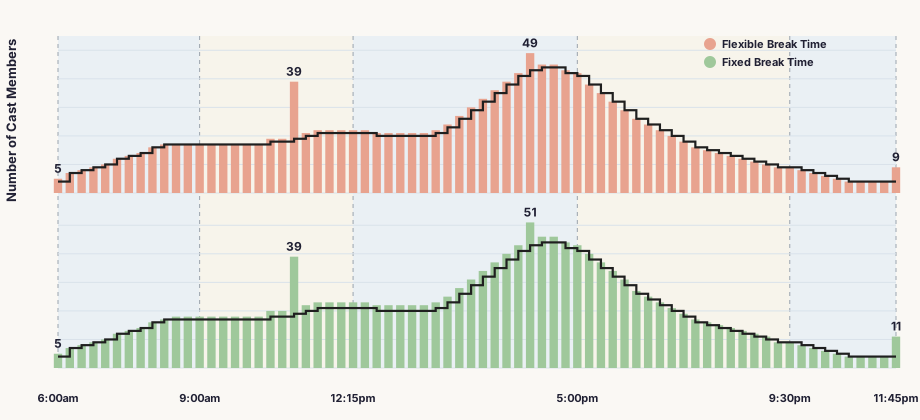
Number of cast members scheduled in each 15-minute period. Orange bars show Scenario 1 (break after exactly 3 or 5 hours); green bars show Scenario 2 (break between hours 2 and 6). The black step line is the workload that must be covered in every period.
- Reduced from 77 to 75 total cast members throughout the day. For one day, the model saved 2 cast members, but adding up for one year, it will save more than 700 cast members. This is a significant reduction in the number of cast members needed to cover the workload for every time period as a big busniess.
Takeaways:
- As a business, sometimes overstaffing is necessary to meet the demand for certain peak periods . However, the model can help to reduce the number of cast members needed to cover the workload for every time period.
- Overschedulled staff can be reassigned to other areas of the park to help with the workload.
Limits of the Model:
- No consideration of specialized positions
- Single-day scheduling analysis only so it cannot be used for long-term planning.
- Reliance on estimated workforce demand data which may not be accurate.
Expansion:
- Reassign overscheduled cast members
- Split up break times
- Vary shift durations
- Hire part-time cast members